
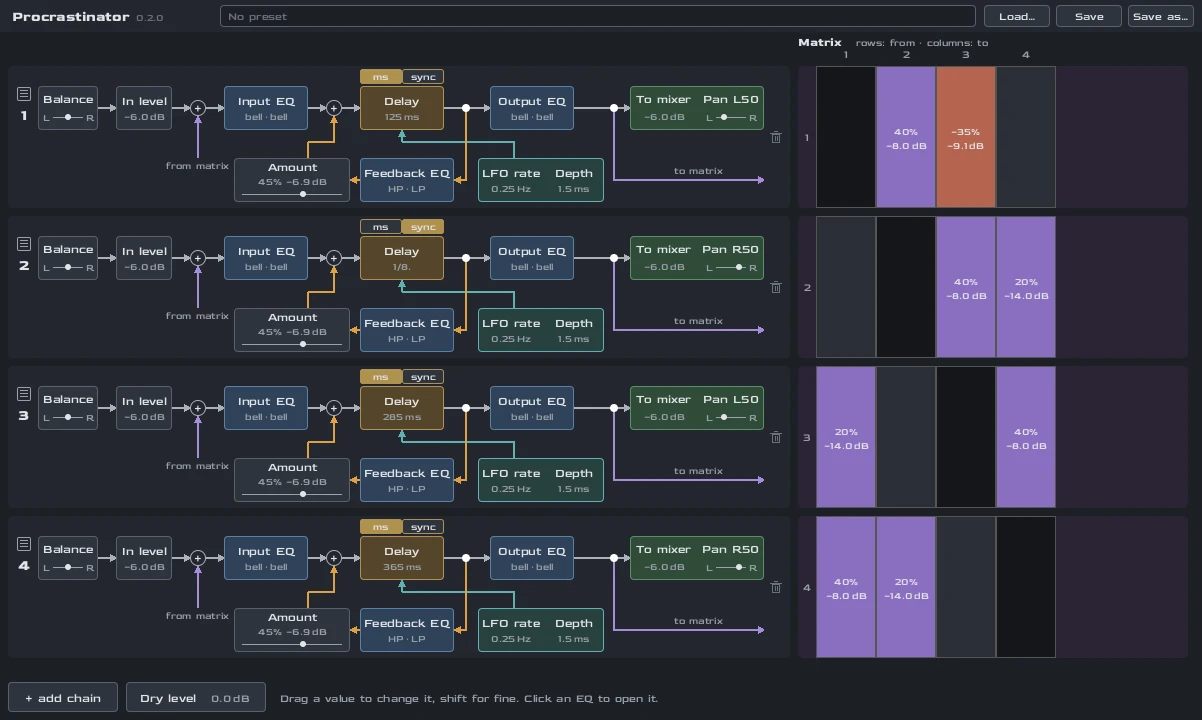
Every chain, drawn as its signal’s path
Each row is one chain, from one to sixteen of them: input level, an EQ, the delay, a feedback path with its own EQ, an LFO that sweeps the delay’s time, an output EQ, and level and pan.
Set a delay in milliseconds or in note values that follow your host’s tempo.
Beside the rows is a matrix, with a row for each chain sending and a column for each chain receiving. Click a cell to send one chain into another, or drag it to set the level, and the echoes start to answer each other.
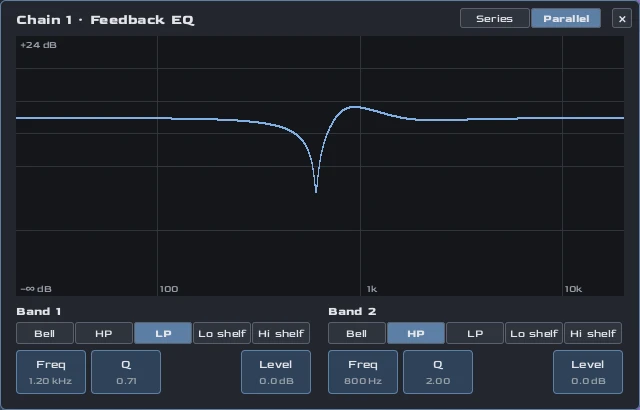
Echoes that hollow out as they return
Each EQ’s two bands can run in series or in parallel. In parallel, nothing corrects the phase between them, so where they overlap they partly cancel and the response gets comb-like dips.
That is meant to be there. In a feedback path the dip stops those frequencies building up, and each repeat comes back hollower than the last. Slide a band’s frequency while the repeats ring to hear it move.
Where it runs
Linux
x86-64 with AVX2 and FMA, about 2013 on, and glibc 2.36 or later, as on Debian 12 and anything newer. Packages are .deb and .rpm, and the window needs X11.
Mac
macOS 26 on Apple silicon, from a signed and notarized disk image.
Your music software
A CLAP and VST3 plugin, plus an Audio Unit on the Mac. Your host can automate its controls and save them with the project, and presets are plain files.
Get Procrastinator
Download a release for Linux or an Apple silicon Mac, or build it from source. The code, instructions and issue tracker are on Forgejo.
Download a release View the project on Forgejo